|
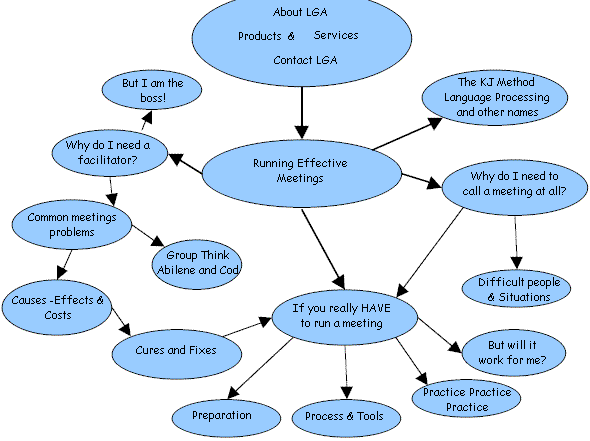
Running
Effective Meetings
Some key benefits of
"doing it right"
- You will have fewer, and shorter
meetings
- Your meetings will be more productive,
that is, better decisions will be made and made more quickly, and people will "buy in" to those
decisions. Buy-in will lead to commitment and commitment to follow-up
action.
The results -
-
Higher
quality plans and decisions
-
Greater
organizational efficiency
-
More
competitive business
-
Higher
staff moral
-
Less
staff turnover
-
Avoid
Groupthink
- You may even reduce staff turnover and
re-training costs!
The system promoted by
LGA is effective in addressing many of the causes of ineffective meetings. We call it "Make Meetings
Work". To find out more, follow the link to If You Really Have to Run
a Meeting.
Return
to top of page
The questions you need to ask are:
- Why should I be concerned about
meetings at all? Costs!
- Why do I run
meetings at all?
- If I really
must run a meeting, what is the objective of the meeting? (and that is
not such a self evident question)
- Knowing the
objective of the meetings, what is the appropriate form for the
meeting?
- If it's
likely that the meeting will have multiple forms how
can I ensure that
the transitions from one form to the other occur effectively? (Because
poorly managed transitions are one of the major causes of ineffective
meetings)
Return
to top of page
Why should we be concerned about meetings?
Because
:
Some research suggests that almost one
third of all meetings are considered unnecessary by the people who attend them!
That is a monumental waste of time! When managers are asked what
are the areas of inefficiency in their daily work their answers tend have
similarities. Meetings are called too frequently, last too long, and often end
with unsatisfactory results.
Return
to top of page
Consider what proportion of meetings in
your organization fit into the category of "unnecessary" Do some of your meetings have the
following characteristics:
- an issue remains unresolved at the end
of the meeting
- the same issue seems to return meeting after meeting
- arguments seem to go "round in circles"
- only a small percentage of the group participate in the discussion
- a small group of people seem to dominate the meeting
- people talk at cross purposes
- all issues are not taken up and systematically dealt with
- people do not remember all the different arguments
- decisions are taken without consensus
- participants do not 'buy in" to the decisions taken at the meeting
- people feel the meeting was a complete waste of time?
Return
to top of page
If
the items above are the things you see, the following are some of the results:
-
frustration and
annoyance to many attendees
-
valuable
productive time is wasted
-
people's attitude becomes counter productive
-
people become discouraged from
attending meetings
-
commitment
to decisions is low
Return
to top of page
How
does the boss stay boss?
A
common concern of managers is they feel that, as the decision maker, they
really have to be the chairperson all the time. This concern is valid and
is addressed in this way. As
boss you decide:
-
What’s
on the agenda (you can invite proposals)
-
Who
attends the meeting
-
What
each person’s role is during the meeting
-
What
the form of the meetings is (ideas gathering, problem solving decision making)
As
boss you:
-
Specify
the scope and ground rules of the meeting
-
Open,
close and supervise transitions from one form of the meeting to another
-
Specify
how much participation you want from participants
-
Specify
at the start of the meeting HOW decisions will be made:
So, as
boss you still have the authority and still have to make the difficult
decisions.
Return
to top of page
But
why do you (as the boss) sometimes need a facilitator?
Because
it’s impossible for the boss to be neutral.
The boss usually has an interest in a particular solution to a problem so how
can he/she be
impartial "You can't be the team quarterback, the referee, and the
score keeper at
the same time without having an unmanageable conflict of interest"
If you
really want to get the "best" decision from a group of
participants you need to get a high level of participation and open
discussion. To achieve this you must stand down from the position of
chairperson or "facilitator".
KJ
Method, Language Processing?
Numerous
terms are used to describe this very effective method for processing
qualitative data. variations of the technique are known as The KJ method,
the Metaplan Method, The Moderation Method and Language Processing. The KJ
method is attributed to a Japanese anthropologist who developed it in the 1950s. It is used in many fields as a follow-on from the ubiquitous
brainstorming technique. The technique is used extensively in the ZOPP or
LFA process and is a very effective tool for managing several aspects of
some types of meeting.
Why
do I Need to Call a Meeting?
Meetings
are called for numerous reasons. For example:
To
pass out or share information to many
To gather information from many
To exchange information between many
To resolve problems
To reach consensus
The
problems that frequently arise at meetings are often caused by:
-
misuse
of meetings, that is using meetings when other means of communication
are better
-
unmanaged
transitions from one type of meeting to another. For example when a
briefing meeting inadvertently turns into a problem solving meetings
for which few of the participants are prepared.
It is
vital that the all-to-often time-consuming meeting be used appropriately
and effectively.
Send mail to jeplewis@gmail.com with questions or
comments about this web site.
Last modified: March 01, 2006
|